Wendy had many great ideas that I learned and for those who could not attend, I would like to share my notes with you in this personal blog. Wendy began her workshop by telling us that not to feel like you are failing when teaching the special needs population of students, embrace the chaos, and release any anxiety because it will never be the ‘perfect’ class. She suggested that we keep in mind to have fun and relax as our main goals, and to remember these three things: Adaptations, Accommodations, and Modifications.She defines Adaptationsas condensing the stories to just the main elements of plot points, and using objects when telling the story. Wendy defined Accommodationsas delivering the same content but using a different mode of delivery to accommodate different disabilities, i.e. posting the book on an Elmo / Smart Board so it is larger (for visually impaired) and easier to share the images to all students. Using an audiobook is another example of modifying the book’s contents to this special needs population, for those students who can listen independently. It allows for repetition of certain sections of the book, if needed. And Wendy suggested Modificationsat storytime, as defined as changing our expectations from the standard, for example, not talking as much as showing more of the images on each page. Or, asking simple questions on each page (“Pick out a flower from the seed on the page. And ask the students, which is the flower and which is the seed?”) She suggested the idea of calling storytime a “Sensory Friendly Storytime.”
This workshop taught me how to better collaborate with professionals in my school, as an example, I learned that Wendy often collaborates with the Speech Language Pathologist (SLP) and suggests inquiring and extracting information from the SLP, extending student’s instructional lessons by integrating library stories to reinforce the SLP language skills being taught, and working collaboratively with the SLP and other therapists on future skills.
An adaptive technology device most often used and successful was the Apple Ipad device, because there are so many ‘Apps’ available for special needs students and most Apps are already being used in the students’ home, especially those technologies used for communication.
This workshop taught me to remember that there are a ‘CAST’ of Characters to consider when planning for our special needs individuals. CASTis an acronym forCommunication, Activity levels, Sensoryand Triggers.I learned that Communicationdesign options might include a yes/no communication board with plexiglass over it (for sanitary reasons) because some students are slower than others in their response time. The goal is to try to get all students involved and for them to feel like they belong. Collaborating with others in your building on individual communication styles (Speech Pathologist, parents?) gives insight into how information is perceived and communicated. Do you talk much slower; do you increase your wait time to 10 seconds; do you allow for longer student processing time? For Activity levels, I learned that students with disabilities may have varying energy levels, high/low, so one needs to determine how long one can sit quietly in order to learn but also enjoy an active or passive program. Fidgets can be helpful for those with low tolerance to activity. Sensoryin ‘CAST’ is for Sensory Processing Disorders, for individuals who are oversensitive in their environment. Common sounds may be painful or overwhelming. If the environment is too sunny or bright, you could redirect the program away from window lighting. Students with disabilities can be unpredictable; even a high pitched tone of voice may be overwhelming. And lastly, Triggers can lead to unpredictable behaviors; perfumes, dogs, change in seating or schedules could be a surprising trigger. Ask the parents, teachers, and colleagues for information of any triggers the student may have. Plan to give these students an ‘out’ or a safe place to escape to where the student can take a break. Maybe give the student a “Take A Break” token and collect the token at the end of the class (using Token Systems.)
I learned that it's important to ask parents for their input on how you can help their child succeed in school by starting the conversation with positivity, and then later discussing the observations you noticed in the library that you want to address. Wendy acknowledges that Public Librarians will have more difficulty than a School Librarian in determining student library needs and limitations due to privacy, confidentiality issues, and HIPPA rules (teachers have access to students’ files) and advises not to use the word “autism” when planning specific programs in public libraries.
I learned that these students are not bored with repetition; they love routine, so continue with the same schedule. It’s even ok to review or repeat a lesson, scaffolding to it weekly. Repeating and modifying the same lesson three to four times is acceptable; the end goal will be more attainable with repetition.
Sometakeaway ideas I learned when teaching in the Library to multi-handicapped students include using digital devices such as an Elmo document camera; taking pictures with your cell phone and uploading the images to an Ipad device; cut out a square within a black piece of paper and while using a document camera only focus on certain areas of the page. Talking Books Plus (audio books) are also a nice option because the story can be slowed. Some public and school libraries use the ‘Tumblebooks’ database, where the stories come alive in voice and can be designed to be read aloud in a continuous playlist, with the class or independently. Pebble Go is also another database of NonFiction book titles for Kindergarten to Grade 2, including worksheets that are compatible with the Ipad device. Other colleagues mentioned other technologies they found helpful: the YES/NO app., Pictello, Proloquo, Popplet, and New To You.
I especially liked and will implement in my library the workshop’s discussion and presentation of items from Boardmaker (disk and online) for making Social Stories (narratives) and visual cues for student expectations during library class. The standardized visual images work well with this population of students because they are used by other colleagues in the school, so they are accustomed to this format. Another option is to take pictures of actual objects and use those in Visual Cues and Social Stories. I used Boardmaker for my visual cue routines, and also perused Pinterest to look for ideas. It’s amazing the wealth of educator resources such as visual cue routines that are already completed.
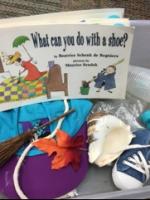
Another fun and easy idea I will implement in my school library is to create a “Scavenger Hunt Book Box” to coordinate with book titles. These story boxes contain a variety of items mentioned in the story of the book. They are stored in a box or plastic shoe box, and include artifacts that align with the story, making it an ideal way to read to and keep the interest of students with disabilities and those on the autism spectrum. As the Librarian reads the story, she can pull items from the box and then pass it around to the students. Using actual objects during storytelling works well for Autistic, Deaf, and Visually Impaired students. One could even purchase flower boxes, create dividers within it, call it a ‘Story Box’ and place appropriate story props inside. I love this idea; so simple, affordable and meaningful to students. Wendy had many story boxes and acknowledged that its only downside was in the storing of all the boxes. Some story box contents can be purchased as a kit but it is less expensive to create items on your own.
The most important takeaway was to keep trying different strategies for a successful storytime, refrain from feeling like a failure if the initiative failed, and collaborate with colleagues who can model their successes. This professional development workshop can easily and quickly be implemented: story boxes are relatively low cost; collaboration on various technologies with the student’s team of Special Education professionals increases successful goal setting; and integrating student and classroom digital devices such as Ipad applications, Talking Book technologies, and voiced storytime databases allows for best instructional practices for the school and home learning communities.